Table of Contents
Singapore's family office sector has exploded tenfold in just five years, surpassing 2,000 single-family offices in 2024, yet many families still struggle to understand the true costs involved. Family office services can mean anything from a lean coordination team to a fully-staffed operation with dedicated investment professionals, making cost estimates vary dramatically.
This guide breaks down family office costs into three components: management fees, operating expenses, and setup costs. We'll explore pricing across different models and identify the key drivers that determine whether you'll pay $200,000 or $6 million annually.
If you are a high-net-worth family, wealth manager, or advisor seeking to understand the full cost structure, then this article is for you.
This is general information for educational purposes. Actual costs vary significantly by jurisdiction, scope, and family complexity.
Quick answer: typical family office services costs
Understanding family office costs starts with recognising the different pricing structures:
Management fee structures by model:
-
AUM-based fees: 0.5% to 1.5% of assets under management, typically stepping down as assets grow
-
Fixed annual retainer: $200,000 to $500,000 for lean operations; larger offices ($1 billion+ AUM) average $6.1 million annually
-
Hybrid models: Base retainer plus reduced AUM fees (0.25% to 0.75%)
-
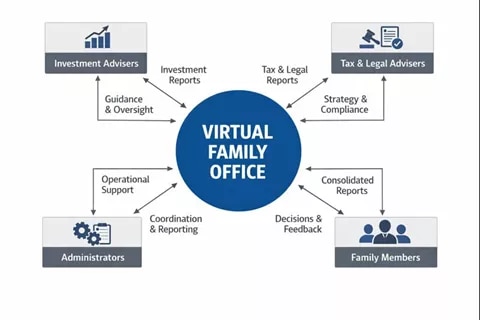
Virtual/outsourced: Up to 1% of AUM for coordination and oversight
-
Multi-family office: 0.2% to 1.25% of AUM, with varying minimum commitments
Management fees vs total costs: Fees = What you pay the service provider Costs = Everything including fees, staff, technology, compliance, and infrastructure
Total family office costs typically range from 30 to 120 basis points of AUM, reaching 1.5% to 3% when including all operational expenses.
Family office management fees explained
Each pricing model aligns incentives differently and suits specific situations:
AUM-based fees
Charges 0.5% to 1.5% annually, scaling with portfolio size. Covers investment oversight, reporting, and basic administration. Hidden costs include custody fees, transaction costs, and underlying fund expenses, adding another 50-100 basis points.
This model works particularly well for liquid portfolios where valuation is straightforward. However, families with substantial illiquid holdings like private businesses or real estate may find AUM models problematic, as these assets require periodic valuations that can be subjective and costly.
Fixed annual retainer
Ranges from $200,000 to several million for predictable costs. Best when service scope remains stable and families want to avoid market-linked fee volatility.
Retainer models have gained popularity post-2022 when market volatility made AUM-based fees unpredictable. For instance, a family paying 1% on $100 million saw fees swing by $200,000 as markets moved 20%. Fixed retainers eliminate this uncertainty, though providers often include escalation clauses of 3-5% annually.
Hybrid pricing
Combines base retainer with reduced AUM fees. For instance, a typical arrangement might involve $150,000 retainer plus 0.35% of liquid assets. Balances operational coverage with performance alignment whilst protecting wealth.
Performance fees
Typically 10-20% of gains above benchmarks, common for direct investments. Critical to clarify: benchmark selection, high-water marks, and whether these stack on management fees.
Hourly/project
Generally $250-$750 hourly for discrete projects. Useful for setup phases or specific initiatives like restructuring operations.
The biggest cost drivers
Several factors can swing costs by millions annually:
People and seniority
Staffing represents 60-70% of operating costs. For example, hiring a former Goldman partner as CIO might cost $2 million annually, whilst a mid-level manager typically costs $300,000. Singapore professionals command estimated salaries of SGD 250,000-800,000, roughly 40% more than regional alternatives.
The talent war has intensified with Singapore's family office boom. Investment professionals with family office experience now command premium salaries, often including guaranteed bonuses and co-investment opportunities. Some families address this by hiring promising juniors and investing in their development, though this requires patience and carries execution risk.
Complexity multipliers
Consider two hypothetical $100 million families:
-
Simple structure: Single jurisdiction, one business, three heirs = estimated $400,000 annually (0.4% AUM)
-
Complex structure: Five jurisdictions, 15 entities, 25 beneficiaries across three generations = estimated $1.8 million (1.8% AUM)
Each jurisdiction typically adds an estimated $50,000-150,000 in compliance costs alone.
Technology requirements
Typical technology costs might include:
-
Portfolio management: $100,000-250,000
-
Cybersecurity: $150,000-500,000
-
Document management: $30,000-80,000
Consider: Industry estimates suggest data breaches could average $5 million in damages.
Office overhead
Singapore CBD space typically costs SGD 100-150 per square foot monthly. For instance, a 5,000 square foot office could mean SGD 1.8 million annually before fit-out or utilities.
Costs by model: SFO vs MFO vs virtual
Single-family office (SFO)
Costs 1-1.5% of AUM annually. Hidden expense: redundancy requirements typically add an estimated 30-40% to staffing costs. Advantage: instant pivoting capability for investment changes.
A dedicated family office provides complete control and customisation but requires substantial commitment. Beyond the financial costs, families must be prepared to manage an organisation, handle HR issues, and maintain governance structures. This often suits families with operating businesses who already have management infrastructure.
Multi-family office (MFO)
Charges 0.2-1.25% of AUM. Hidden cost: "committee tax" where decisions requiring consensus can delay exits. For example, delays could potentially cost millions. Benefit: institutional memory prevents costly mistakes.
MFOs have evolved significantly, with many now offering "pod" structures where families maintain independence whilst sharing back-office costs. This addresses the traditional MFO criticism of "lowest common denominator" service. However, the most sophisticated MFOs often have minimum requirements of $50-100 million, excluding smaller families.
Virtual/outsourced
Runs 0.3-0.8% of AUM. Hidden cost: principals often report spending 15-20 hours weekly coordinating providers, time potentially worth $500,000+ annually. Best for transition periods whilst determining permanent structure.
|
Model
|
Typical cost
|
Best for
|
Key limitation
|
|
SFO
|
1-1.5% AUM
|
$250M+ wanting control
|
85% costs fixed year one
|
|
MFO
|
0.2-1.25% AUM
|
$50-250M seeking quality
|
Committee delays
|
|
Virtual
|
0.3-0.8% AUM
|
Testing/transitioning
|
Coordination time
|
Where Servcorp fits in the cost stack
Running a family office requires professional infrastructure without locking in unnecessary costs. Servcorp, operating 150+ locations across 40 cities, provides the operational foundation whilst you manage wealth.
Infrastructure you can establish immediately
Servcorp employs 10 team members per 100 offices, five times the industry average. Principals get:
-
Premium Singapore addresses: Marina Bay Financial Centre, CapitaGreen, Suntec Tower for credibility without commitment
-
Dedicated bilingual teams: Professional receptionists and secretaries handling calls, correspondence, and administration
-
Instant scalability: Expand or contract monthly versus 3-5 year lease commitments as operations evolve
-
Regional consistency: Same standards across Singapore, Tokyo, Shanghai, London, Dubai
Morgan Stanley, J.P. Morgan, and Cartier have used Servcorp's infrastructure for sophisticated operations.
What Servcorp doesn't replace
Servcorp provides workspace and operations, not investment management, tax structuring, or wealth planning. Think of it as the foundation upon which you build your chosen model.
Who benefits most
-
New families: Avoid estimated SGD 500,000-2M fit-out costs whilst establishing operations
-
Lean models: Maintain Grade A presence whilst keeping expenses variable
-
Regional operations: Consistent infrastructure across Asia-Pacific markets
|
Aspect
|
Traditional lease
|
Servcorp
|
|
Setup time
|
3-6 months
|
24 hours
|
|
Upfront cost
|
SGD 500K-2M (estimated)
|
First month only
|
|
Professional support
|
Hire/train own team
|
10+ staff included
|
|
Meeting rooms
|
What you build
|
150+ locations globally
|
Frequently Asked Questions